Permalink copied!
Before continuing with more examples of compound data and data
abstraction, let us consider some of the issues raised by the
rational-number example. We defined the rational-number operations in
terms of a constructor
make_rat
and selectors numer and
denom. In general, the underlying idea of data
abstraction is to identify for each type of data object a basic set of
operations in terms of which all manipulations of data objects of that type
will be expressed, and then to use only those operations in manipulating the
data.
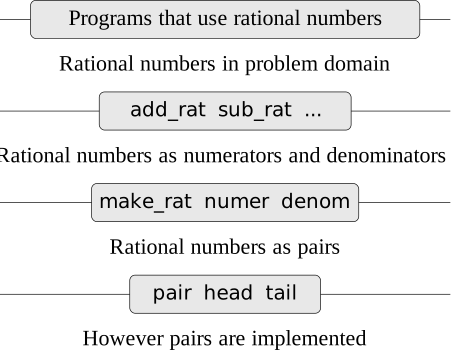
Figure 2.2
Data-abstraction barriers in the rational-number package.
We can envision the structure of the rational-number system as
shown in
figure 2.2.
The horizontal lines represent abstraction barriers that isolate
different
levelsof the system. At each level, the barrier separates the programs (above) that use the data abstraction from the programs (below) that implement the data abstraction. Programs that use rational numbers manipulate them solely in terms of the functions supplied
for public useby the rational-number package: add_rat, sub_rat, mul_rat, div_rat, and equal_rat. These, in turn, are implemented solely in terms of the constructor and selectors make_rat, numer, and denom, which themselves are implemented in terms of pairs. The details of how pairs are implemented are irrelevant to the rest of the rational-number package so long as pairs can be manipulated by the use of pair, head, and tail. In effect, functions at each level are the interfaces that define the abstraction barriers and connect the different levels.
This simple idea has many advantages. One advantage is that it makes
programs much easier to maintain and to modify. Any complex data
structure can be represented in a variety of ways with the primitive
data structures provided by a programming language. Of course, the
choice of representation influences the programs that operate on it;
thus, if the representation were to be changed at some later time, all
such programs might have to be modified accordingly. This task could
be time-consuming and expensive in the case of large programs unless
the dependence on the representation were to be confined by design to
a very few program modules.
For example, an alternate way to address the problem of
reducing rational
numbers to lowest terms is to perform the reduction whenever we
access the parts of a rational number, rather than when we construct
it. This leads to different constructor and selector
functions:
function make_rat(n, d) {
    return pair(n, d);
}
function numer(x) {
    const g = gcd(head(x), tail(x));
    return head(x) / g;
}
function denom(x) {
    const g = gcd(head(x), tail(x));
    return tail(x) / g;
}
The difference between this implementation and the previous one lies in when
we compute the gcd. If in our typical use of
rational numbers we access the numerators and denominators of the same
rational numbers many times, it would be preferable to compute the
gcd when the rational numbers are constructed.
If not, we may be better off waiting until access time to compute the
gcd. In any case, when we change from one
representation to the other, the
functions
add_rat,
sub_rat,
and so on do not have to be modified at all.
Constraining the dependence on the representation to a few interface
functions
helps us design programs as well as modify them, because it allows us to
maintain the flexibility to consider alternate implementations. To continue
with our simple example, suppose we are designing a rational-number package
and we can't decide initially whether to perform the
gcd at construction time or at selection time.
The data-abstraction methodology gives us a way to defer that decision
without losing the ability to make progress on the rest of the system.
Consider the problem of representing
line segments in a plane. Each segment is represented as a pair of points:
a starting point and an ending point.
Declare
a constructor
make_segment
and selectors
start_segment
and
end_segment
that define the representation of segments in
terms of points. Furthermore, a point
can be represented as a pair
of numbers: the $x$ coordinate and the
$y$ coordinate. Accordingly, specify a
constructor
make_point
and selectors
x_point
and
y_point
that define this representation. Finally, using your selectors and
constructors,
declare a function
midpoint_segment
that takes a line segment as argument and returns its midpoint (the point
whose coordinates are the average of the coordinates of the endpoints).
To try your
functions,
you'll need a way to print points:
function print_point(p) {
    return display("(" + stringify(x_point(p)) + ", "
                       + stringify(y_point(p)) +        ")");
}function x_point(x) {
return head(x);
}
function y_point(x) {
return tail(x);
}
function make_point(x, y) {
return pair(x, y);
}
function make_segment(start_point, end_point) {
return pair(start_point, end_point);
}
function start_segment(x) {
return head(x);
}
function end_segment(x) {
return tail(x);
}
function average(a, b) {
return (a + b) / 2;
}
function mid_point_segment(x) {
const a = start_segment(x);
const b = end_segment(x);
return make_point(average(x_point(a),
x_point(b)),
average(y_point(a),
y_point(b)));
}
Implement a representation for
rectangles in a plane. (Hint: You may want to
make use of exercise 2.2.) In terms of your
constructors and selectors, create
functions
that compute the perimeter and the area of a given rectangle. Now implement
a different representation for rectangles. Can you design your system with
suitable abstraction barriers, so that the same perimeter and area
functions
will work using either representation?
First implementation:
function make_point(x, y){
    return pair(x, y);
}
function x_point(x){
    return head(x);
}
function y_point(x){
    return tail(x);
}

function make_rect(bottom_left, top_right){
    return pair(bottom_left, top_right);
}

function top_right(rect){
    return tail(rect);
}

function bottom_right(rect){
    return make_point(x_point(tail(rect)),
                      y_point(head(rect)));
}

function top_left(rect){
    return make_point(x_point(head(rect)),
                      y_point(tail(rect)));
}

function bottom_left(rect){
    return head(rect);
}

function abs(x){
    return x < 0 ? - x : x;
}

function width_rect(rect){
    return abs(x_point(bottom_left(rect)) -
               x_point(bottom_right(rect)));
}

function height_rect(rect){
    return abs (y_point(bottom_left(rect)) -
                y_point(top_left(rect)));
}

function area_rect(rect){
  return width_rect(rect) * height_rect(rect);
}

function perimeter_rect(rect){
  return 2 * (width_rect(rect) + height_rect(rect));
}
Second implementation:
function make_point(x, y){
    return pair(x, y);
}

function make_rect(bottom_left, width, height){
    return pair(bottom_left, pair(width, height));
}

function height_rect(rect){
    return tail(tail(rect));
}

function width_rect(rect){
  return head(tail(rect));
}

function area_rect(rect){
  return width_rect(rect) * height_rect(rect);
}

function perimeter_rect(rect){
  return 2 * (width_rect(rect) + height_rect(rect));
}
2.1.2
Abstraction Barriers