Permalink copied!
We will develop a system that performs arithmetic operations on complex
numbers as a simple but unrealistic example of a program that uses generic
operations. We begin by discussing two plausible representations for
complex numbers as ordered pairs: rectangular form (real part and imaginary
part) and polar form (magnitude and angle).
[1]
Like rational numbers, complex numbers are naturally represented as ordered
pairs. The set of complex numbers can be thought of as a two-dimensional
space with two orthogonal axes, the
\[
\begin{array}{lll}
\mbox{Real-part}(z_{1}+z_{2}) & = &
\mbox{Real-part}(z_{1})+\mbox{Real-part}(z_{2}) \\[1ex]
\mbox{Imaginary-part}(z_{1} +z_{2}) & = &
\mbox{Imaginary-part}(z_1)+\mbox{Imaginary-part}(z_2)
\end{array}
\]
realaxis and the
imaginaryaxis. (See figure 2.30.) From this point of view, the complex number $z=x+iy$ (where $i^{2} =-1$) can be thought of as the point in the plane whose real coordinate is $x$ and whose imaginary coordinate is $y$. Addition of complex numbers reduces in this representation to addition of coordinates:
When multiplying complex numbers, it is more natural to think in terms
of representing a complex number in polar form, as a magnitude and an
angle ($r$ and $A$
in figure 2.30). The product of two
complex numbers is the vector obtained by stretching one complex number by
the length of the other and then rotating it through the angle of the other:
\[
\begin{array}{lll}
\mbox{Magnitude}(z_{1}\cdot z_{2}) & = &
\mbox{Magnitude}(z_{1})\cdot\mbox{Magnitude}(z_{2})\\[1ex]
\mbox{Angle}(z_{1}\cdot z_{2}) & = &
\mbox{Angle}(z_{1})+\mbox{Angle}(z_{2})
\end{array}
\]
Thus, there are two different representations for complex numbers,
which are appropriate for different operations. Yet, from the
viewpoint of someone writing a program that uses complex numbers, the
principle of data abstraction suggests that all the operations for
manipulating complex numbers should be available regardless of which
representation is used by the computer. For example, it is often
useful to be able to find the magnitude of a complex number that is
specified by rectangular coordinates. Similarly, it is often useful
to be able to determine the real part of a complex number that is
specified by polar coordinates.
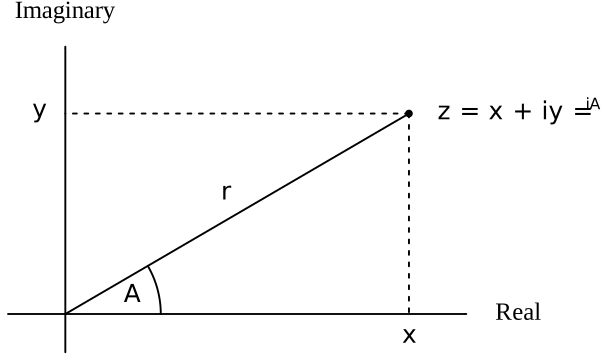
Figure 2.30
Complex numbers as points in the plane.
To design such a system, we can follow the same
data-abstraction strategy we followed in designing the rational-number
package in section 2.1.1. Assume that the
operations on complex numbers are implemented in terms of four selectors:
real_part,
imag_part,
magnitude,
and angle. Also assume that we have two
functions
for constructing complex numbers:
make_from_real_imag
returns a complex number with specified real and imaginary parts, and
make_from_mag_ang
returns a complex number with specified magnitude and angle. These
functions
have the property that, for any complex number
z, both
make_from_real_imag(real_part(z), imag_part(z));
make_from_mag_ang(magnitude(z), angle(z));
produce complex numbers that are equal to z.
Using these constructors and selectors, we can implement arithmetic on
complex numbers using the
abstract dataspecified by the constructors and selectors, just as we did for rational numbers in section 2.1.1. As shown in the formulas above, we can add and subtract complex numbers in terms of real and imaginary parts while multiplying and dividing complex numbers in terms of magnitudes and angles:
function add_complex(z1, z2) {
    return make_from_real_imag(real_part(z1) + real_part(z2),
                               imag_part(z1) + imag_part(z2));
}
function sub_complex(z1, z2) {
    return make_from_real_imag(real_part(z1) - real_part(z2),
                               imag_part(z1) - imag_part(z2));
}
function mul_complex(z1, z2) {
    return make_from_mag_ang(magnitude(z1) * magnitude(z2),
                             angle(z1) + angle(z2));
}
function div_complex(z1, z2) {
    return make_from_mag_ang(magnitude(z1) / magnitude(z2),
                             angle(z1) - angle(z2));
}
To complete the complex-number package, we must choose a representation and
we must implement the constructors and selectors in terms of primitive
numbers and primitive list structure. There are two obvious ways to do
this: We can represent a complex number in
rectangular formas a pair (real part, imaginary part) or in
polar formas a pair (magnitude, angle). Which shall we choose?
In order to make the different choices concrete, imagine that there are two
programmers, Ben Bitdiddle and Alyssa P. Hacker, who are independently
designing representations for the complex-number system.
Ben chooses to represent
complex numbers in rectangular form. With this
choice, selecting the real and imaginary parts of a complex number is
straightforward, as is constructing a complex number with given real and
imaginary parts. To find the magnitude and the angle, or to construct a
complex number with a given magnitude and angle, he uses the trigonometric
relations
\[
\begin{array}{lllllll}
x & = & r\ \cos A & \quad \quad \quad & r & = & \sqrt{x^2 +y^2} \\
y & = & r\ \sin A & & A &= & \arctan (y,x)
\end{array}
\]
which relate the real and imaginary parts ($x$,
$y$) to the magnitude and the angle
$(r, A)$.
[2]
Ben's representation is therefore given by the following selectors
and constructors:
function real_part(z) { return head(z); }

function imag_part(z) { return tail(z); }

function magnitude(z) {
    return math_sqrt(square(real_part(z)) + square(imag_part(z)));
}
function angle(z) {
    return math_atan2(imag_part(z), real_part(z));
}
function make_from_real_imag(x, y) { return pair(x, y); }

function make_from_mag_ang(r, a) {
    return pair(r * math_cos(a), r * math_sin(a));
}
Alyssa, in contrast, chooses to represent complex numbers in
polar form.
For her, selecting the magnitude and angle is straightforward, but she has
to use the
trigonometric relations to obtain the real and imaginary parts.
Alyssa's representation is:
function real_part(z) {
    return magnitude(z) * math_cos(angle(z));
}
function imag_part(z) {
    return magnitude(z) * math_sin(angle(z));
}
function magnitude(z) { return head(z); }

function angle(z) { return tail(z); }

function make_from_real_imag(x, y) {
    return pair(math_sqrt(square(x) + square(y)),
                math_atan2(y, x));
}
function make_from_mag_ang(r, a) { return pair(r, a); }
The discipline of data abstraction ensures that the same implementation of
add_complex,
sub_complex,
mul_complex,
and
div_complex
will work with either Ben's representation or Alyssa's
representation.
[1]
In actual computational
systems, rectangular form is preferable to polar form most of the time
because of
roundoff errors in conversion between rectangular and polar form. This is
why the complex-number example is unrealistic. Nevertheless, it provides a
clear illustration of the design of a system using generic operations and a
good introduction to the more substantial systems to be developed later in
this chapter.
[2]
The arctangent function
referred to
here,
computed by JavaScript's
math_atan2 function,
is defined so as to take two arguments
$y$ and $x$
and to return the angle whose tangent is $y/x$.
The signs of the arguments determine the quadrant of the angle.
2.4.1
Representations for Complex Numbers