Permalink copied!
We have introduced data abstraction, a methodology for structuring systems
in such a way that much of a program can be specified independent of the
choices involved in implementing the data objects that the program
manipulates. For example, we saw in
section 2.1.1 how to separate the task of
designing a program that uses rational numbers from the task of implementing
rational numbers in terms of the computer language's primitive
mechanisms for constructing compound data. The key idea was to erect an
abstraction barrier—in this case, the selectors and constructors for
rational numbers
(make_rat,
numer,
denom)—that isolates the way rational
numbers are used from their underlying representation in terms of list
structure. A similar abstraction barrier isolates the details of the
functions
that perform rational arithmetic
(add_rat,
sub_rat,
mul_rat,
and
div_rat)
from the
higher-levelfunctions that use rational numbers. The resulting program has the structure shown in figure 2.2.
These data-abstraction barriers are powerful tools for controlling
complexity. By isolating the underlying representations of data
objects, we can divide the task of designing a large program into
smaller tasks that can be performed separately. But this kind of data
abstraction is not yet powerful enough, because it may not always make
sense to speak of
the underlying representationfor a data object.
For one thing, there might be more than one useful representation for
a data object, and we might like to design systems that can deal with
multiple representations. To take a simple example, complex numbers
may be represented in two almost equivalent ways: in rectangular form
(real and imaginary parts) and in polar form (magnitude and angle).
Sometimes rectangular form is more appropriate and sometimes polar
form is more appropriate. Indeed, it is perfectly plausible to
imagine a system in which complex numbers are represented in both
ways, and in which the
functions
for manipulating complex numbers work with either representation.
More importantly, programming systems are often designed by many
people working over extended periods of time, subject to requirements
that change over time. In such an environment, it is simply not
possible for everyone to agree in advance on choices of data
representation. So in addition to the data-abstraction barriers that
isolate representation from use, we need abstraction barriers that
isolate different design choices from each other and permit different
choices to coexist in a single program. Furthermore, since large
programs are often created by combining
preexisting
modules that were
designed in isolation, we need conventions that permit programmers to
incorporate modules into larger systems
additively, that is,
without having to redesign or reimplement these modules.
In this section, we will learn how to cope with data that may be
represented in different ways by different parts of a program. This
requires constructing
generic functions—functions
that can operate on data that may be represented in more than one way. Our
main technique for building generic
functions
will be to work in terms of data objects that have
type tags, that is, data objects that include explicit information
about how they are to be processed. We will also discuss
data-directed programming, a powerful and convenient
implementation strategy for additively assembling systems with generic
operations.
We begin with the simple complex-number example. We will see how
type tags and data-directed style enable us to design separate
rectangular and polar representations for complex numbers while
maintaining the notion of an abstract
complex-numberdata object. We will accomplish this by defining arithmetic functions for complex numbers (add_complex, sub_complex, mul_complex, and div_complex) in terms of generic selectors that access parts of a complex number independent of how the number is represented. The resulting complex-number system, as shown in figure 2.29, contains two different kinds of abstraction barriers. The
horizontalabstraction barriers play the same role as the ones in figure 2.2. They isolate
higher-leveloperations from
lower-levelrepresentations. In addition, there is a
verticalbarrier that gives us the ability to separately design and install alternative representations.
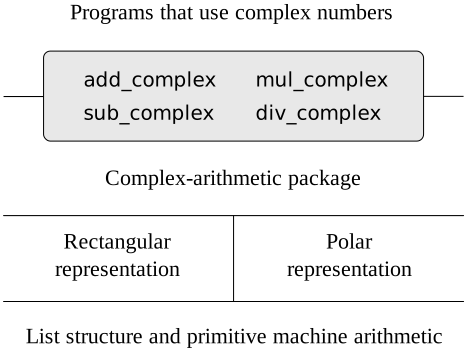
Figure 2.29
Data-abstraction barriers in the
complex-number system.
In section 2.5 we will show how to
use type tags and data-directed style to develop a generic arithmetic
package. This provides
functions
(add, mul, and so
on) that can be used to manipulate all sorts of
numbersand can be easily extended when a new kind of number is needed. In section 2.5.3, we'll show how to use generic arithmetic in a system that performs symbolic algebra.
2.4
Multiple Representations for Abstract Data