In section 5.1 we saw how to transform simple JavaScript programs into descriptions of register machines. We will now perform this transformation on a more complex program, the metacircular evaluator of sections 4.1.1–4.1.4, which shows how the behavior of a JavaScript interpreter can be described in terms of the functions evaluate and apply. The explicit-control evaluator that we develop in this section shows how the underlying function-calling and argument-passing mechanisms used in the evaluation process can be described in terms of operations on registers and stacks. In addition, the explicit-control evaluator can serve as an implementation of a JavaScript interpreter, written in a language that is very similar to the native machine language of conventional computers. The evaluator can be executed by the register-machine simulator of section 5.2. Alternatively, it can be used as a starting point for building a machine-language implementation of a JavaScript evaluator, or even a special-purpose machine for evaluating JavaScript programs. Figure 5.21 shows such a hardware implementation: a silicon chip that acts as an evaluator for Scheme, the language used in place of JavaScript in the original edition of this book. The chip designers started with the data-path and controller specifications for a register machine similar to the evaluator described in this section and used design automation programs to construct the integrated-circuit layout.[1]
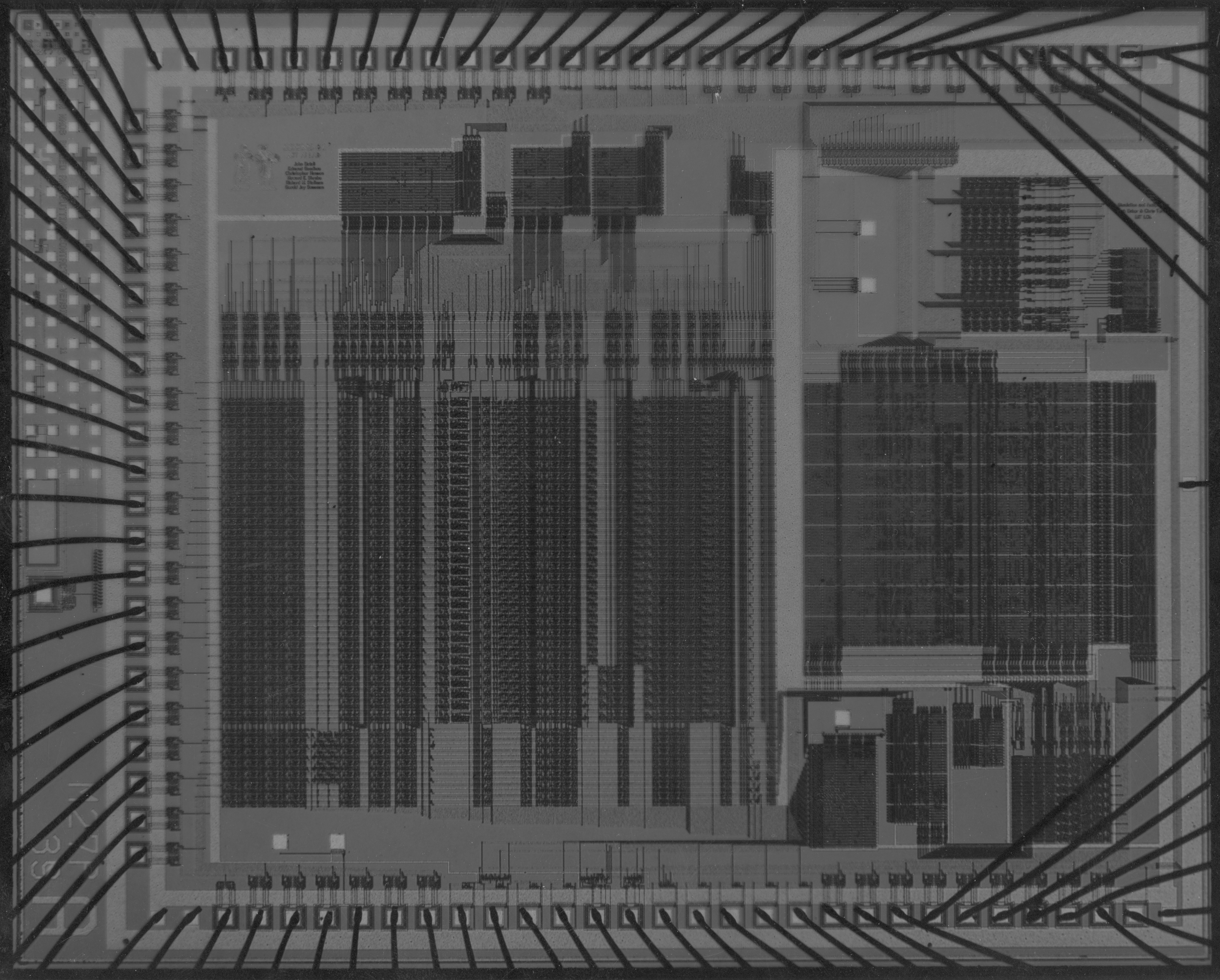
In designing the explicit-control evaluator, we must specify the operations to be used in our register machine. We described the metacircular evaluator in terms of abstract syntax, using functions such as is_literal and make_function. In implementing the register machine, we could expand these functions into sequences of elementary list-structure memory operations, and implement these operations on our register machine. However, this would make our evaluator very long, obscuring the basic structure with details. To clarify the presentation, we will include as primitive operations of the register machine the syntax functions given in section 4.1.2 and the functions for representing environments and other runtime data given in sections 4.1.3 and 4.1.4. In order to completely specify an evaluator that could be programmed in a low-level machine language or implemented in hardware, we would replace these operations by more elementary operations, using the list-structure implementation we described in section 5.3.
Our JavaScript evaluator register machine includes a stack and seven registers: comp, env, val, continue, fun, argl, and unev. The comp register is used to hold the component to be evaluated, and env contains the environment in which the evaluation is to be performed. At the end of an evaluation, val contains the value obtained by evaluating the component in the designated environment. The continue register is used to implement recursion, as explained in section 5.1.4. (The evaluator needs to call itself recursively, since evaluating a component requires evaluating its subcomponents.) The registers fun, argl, and unev are used in evaluating function applications.
We will not provide a data-path diagram to show how the registers and operations of the evaluator are connected, nor will we give the complete list of machine operations. These are implicit in the evaluator's controller, which will be presented in detail.