Permalink copied!
In the previous examples we built representations for two kinds of
compound data objects: rational numbers and algebraic expressions. In
one of these examples we had the choice of simplifying (reducing) the
expressions at either construction time or selection time, but other
than that the choice of a representation for these structures in terms
of lists was straightforward. When we turn to the representation of
sets, the choice of a representation is not so obvious. Indeed, there
are a number of possible representations, and they differ
significantly from one another in several ways.
Informally, a set is simply a collection of distinct objects. To give
a more precise definition we can employ the method of data
abstraction. That is, we define
[1]
setby specifying the operations that are to be used on sets. These are union_set, intersection_set, is_element_of_set, and adjoin_set. The function is_element_of_set is a predicate that determines whether a given element is a member of a set. The function adjoin_set takes an object and a set as arguments and returns a set that contains the elements of the original set and also the adjoined element. The function union_set computes the union of two sets, which is the set containing each element that appears in either argument. The function intersection_set computes the intersection of two sets, which is the set containing only elements that appear in both arguments. From the viewpoint of data abstraction, we are free to design any representation that implements these operations in a way consistent with the interpretations given above.
One way to represent a set is as a list of its elements in which no
element appears more than once. The empty set is represented by the
empty list. In this representation,
is_element_of_set
is similar to the
function
member
of section 2.3.1.
It uses
equal
instead of
===
so that the set elements need not be
just numbers or strings:
function is_element_of_set(x, set) {
    return is_null(set)
           ? false
           : equal(x, head(set))
           ? true
           : is_element_of_set(x, tail(set));
}
Using this, we can write
adjoin_set.
If the object to be adjoined is already in the set, we just return the set.
Otherwise, we use
pair
to add the object to the list that represents the set:
function adjoin_set(x, set) {
    return is_element_of_set(x, set)
           ? set
           : pair(x, set);
}
For
intersection_set
we can use a recursive strategy. If we know how to form the intersection
of set2 and the
tail
of set1, we only need to decide whether to
include the
head
of set1 in this. But this depends on whether
head(set1)
is also in set2. Here is the resulting
function:
function intersection_set(set1, set2) {
    return is_null(set1) || is_null(set2)
           ? null
           : is_element_of_set(head(set1), set2)
           ? pair(head(set1), intersection_set(tail(set1), set2))
           : intersection_set(tail(set1), set2);
}
In designing a representation, one of the issues we should be concerned
with is efficiency. Consider the number of steps required by our set
operations. Since they all use
is_element_of_set,
the speed of this operation has a major impact on the efficiency of the set
implementation as a whole. Now, in order to check whether an object is a
member of a set,
is_element_of_set
may have to scan the entire set. (In the worst case, the object turns out
not to be in the set.) Hence, if the set has
$n$ elements,
is_element_of_set
might take up to $n$ steps. Thus, the number of
steps required grows as $\Theta(n)$. The number
of steps required by
adjoin_set,
which uses
this operation, also grows as $\Theta(n)$. For
intersection_set,
which does an
is_element_of_set
check for each element of set1, the number of
steps required grows as the product of the sizes of the sets involved, or
$\Theta(n^{2})$ for two sets of size
$n$. The same will be true of
union_set.
Implement the
union_set
operation for the unordered-list representation of sets.
function union_set(set1, set2) {
    return is_null(set1)
           ? set2
           : adjoin_set(head(set1),
                        union_set(tail(set1), set2));
}
We specified that a set would be represented as a list with no duplicates.
Now suppose we allow duplicates. For instance, the set
$\{1,2,3\}$ could be represented as the list
list(2, 3, 2, 1, 3,
2, 2).
Design
functions
is_element_of_set,
adjoin_set,
union_set,
and
intersection_set
that operate on this representation. How does the efficiency of each
compare with the corresponding
function
for the non-duplicate representation? Are there applications for which
you would use this representation in preference to the non-duplicate one?
The functions is_element_of_set and
intersection_set remain unchanged.
Here is the new implementation of
adjoin_set and
union_set.
function adjoin_set(x, set) {
    return pair(x, set);
}
function union_set(set1, set2) {
    return append(set1, set2);
}
In the version with no duplicates, the required number of steps for
is_element_of_set and
adjoin_set has an order of growth of
$O(n)$, where $n$
is the number of element occurrences in the given representation, and
the required number of steps for
intersection_set and
union_set has an order of growth of
$O(n m)$, where $n$
is the number of element occurrences in the representation of the first
set and $m$ is the number of element
occurrences in the representation of the second set. In the version that
allows duplicates, the number of steps for
adjoin_set shrinks to
$O(n)$, and the number of steps for
union_set shrinks to
$O(n)$. However, note that the number of
element occurrences may be much larger in the second version, because
many duplicates may accumulate. For applications where duplicate elements
are rare, the version that allows duplicates is preferrable.
One way to speed up our set operations is to change the representation
so that the set elements are listed in increasing order. To do this,
we need some way to compare two objects so that we can say which is
bigger. For example, we could compare
strings
lexicographically, or
we could agree on some method for assigning a unique number to an
object and then compare the elements by comparing the corresponding
numbers. To keep our discussion simple, we will consider only the
case where the set elements are numbers, so that we can compare
elements using > and
<. We will represent a set of
numbers by listing its elements in increasing order. Whereas our
first representation above allowed us to represent the set
$\{1,3,6,10\}$ by listing the elements in any
order, our new representation allows only the list
list(1, 3, 6, 10).
One advantage of ordering shows up in
is_element_of_set:
In checking for the presence of an item, we no longer have to scan the
entire set. If we reach a set element that is larger than the item we
are looking for, then we know that the item is not in the set:
function is_element_of_set(x, set) {
return is_null(set)
? false
: x === head(set)
? true
: x < head(set)
? false
: // $\texttt{x > head(set)}$
is_element_of_set(x, tail(set));
}
How many steps does this save? In the worst case, the item we are
looking for may be the largest one in the set, so the number of steps
is the same as for the unordered representation. On the other hand,
if we search for items of many different sizes we can expect that
sometimes we will be able to stop searching at a point near the
beginning of the list and that other times we will still need to
examine most of the list. On the average we should expect to have to
examine about half of the items in the set. Thus, the average
number of steps required will be about $n/2$.
This is still $\Theta(n)$ growth, but
it does save us, on the average, a factor of 2 in number of steps over the
previous implementation.
We obtain a more impressive speedup with
intersection_set.
In the unordered representation this operation required
$\Theta(n^2)$ steps, because we performed a
complete scan of set2 for each element of
set1. But with the ordered representation,
we can use a more clever method. Begin by comparing the initial elements,
x1 and
x2, of the two sets. If
x1 equals
x2, then that gives an element of the
intersection, and the rest of the intersection is the intersection of the
tails
of the two sets. Suppose, however, that x1
is less than x2. Since
x2 is the smallest element in
set2, we can immediately conclude that
x1 cannot appear anywhere in
set2 and hence is not in the intersection.
Hence, the intersection is equal to the intersection of
set2 with the
tail
of set1. Similarly, if
x2 is less than
x1, then the intersection is given by the
intersection of set1 with the
tail
of set2. Here is the
function:
function intersection_set(set1, set2) {
if (is_null(set1) || is_null(set2)) {
return null;
} else {
const x1 = head(set1);
const x2 = head(set2);
return x1 === x2
? pair(x1, intersection_set(tail(set1), tail(set2)))
: x1 < x2
? intersection_set(tail(set1), set2)
: // $\texttt{x2 < x1}$
intersection_set(set1, tail(set2));
}
}
To estimate the number of steps required by this process, observe that at
each step we reduce the intersection problem to computing intersections of
smaller sets—removing the first element from
set1 or set2
or both. Thus, the number of steps required is at most the sum of the sizes
of set1 and set2,
rather than the product of the sizes as with the unordered representation.
This is $\Theta(n)$ growth rather than
$\Theta(n^2)$—a considerable speedup,
even for sets of moderate size.
Give an implementation of
adjoin_set
using the ordered representation. By analogy with
is_element_of_set
show how to take advantage of the ordering to produce a
function
that requires on the average about half as many steps as with the unordered
representation.
function adjoin_set(x, set) {
    return is_null(set)
           ? list(x)
           : x === head(set)
           ? set
           : x < head(set)
           ? pair(x, set)
           : pair(head(set),
                  adjoin_set(x, tail(set)));
}
Give a $\Theta(n)$ implementation of
union_set
for sets represented as ordered lists.
function union_set(set1, set2) {
    if (is_null(set1)) {
        return set2;
    } else if (is_null(set2)) {
        return set1;
    } else {
      const x1 = head(set1);
      const x2 = head(set2);
      return x1 === x2
             ? pair(x1, union_set(tail(set1),
                                  tail(set2)))
             : x1 < x2
             ? pair(x1, union_set(tail(set1), set2))
             : pair(x2, union_set(set1, tail(set2)));
    }
}
union_set(
   adjoin_set(10, adjoin_set(20, adjoin_set(30, null))),
   adjoin_set(10, adjoin_set(15, adjoin_set(20, null))));
We can do better than the ordered-list representation by arranging the set
elements in the form of a tree. Each node of the tree holds one element of
the set, called the
entryat that node, and a link to each of two other (possibly empty) nodes. The
leftlink points to elements smaller than the one at the node, and the
rightlink to elements greater than the one at the node. Figure 2.25 shows some trees that represent the set $\{1,3,5,7,9,11\}$. The same set may be represented by a tree in a number of different ways. The only thing we require for a valid representation is that all elements in the left subtree be smaller than the node entry and that all elements in the right subtree be larger.
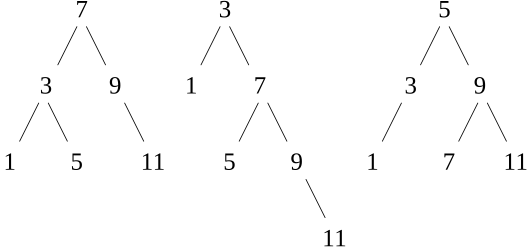
Figure 2.25
Various binary trees that represent the set
$\{ 1,3,5,7,9,11 \}$.
The advantage of the tree representation is this: Suppose we want to check
whether a number $x$ is contained in a set. We
begin by comparing $x$ with the entry in the
top node. If $x$ is less than this, we know
that we need only search the left subtree; if $x$
is greater, we need only search the right subtree. Now, if the tree is
[2]
balanced,each of these subtrees will be about half the size of the original. Thus, in one step we have reduced the problem of searching a tree of size $n$ to searching a tree of size $n/2$. Since the size of the tree is halved at each step, we should expect that the number of steps needed to search a tree of size $n$ grows as $\Theta(\log n)$.
For large sets, this will be a significant speedup over the previous
representations.
We can represent trees by using
lists. Each node will be a list of
three items: the entry at the node, the left subtree, and the right
subtree. A left or a right subtree of the empty list will indicate
that there is no subtree connected there. We can describe this
representation by the following
functions:
[3]
function entry(tree) { return head(tree); }

function left_branch(tree) { return head(tail(tree)); }

function right_branch(tree) { return head(tail(tail(tree))); }

function make_tree(entry, left, right) {
    return list(entry, left, right);
}
Now we can write
is_element_of_set
using the strategy described above:
function is_element_of_set(x, set) {
return is_null(set)
? false
: x === entry(set)
? true
: x < entry(set)
? is_element_of_set(x, left_branch(set))
: // $\texttt{x > entry(set)}$
is_element_of_set(x, right_branch(set));
}
Adjoining an item to a set is implemented similarly and also requires
$\Theta(\log n)$ steps. To adjoin an item
x, we compare
x with the node entry to determine whether
x should be added to the right or to the left
branch, and having adjoined
x to the appropriate branch we piece this
newly constructed branch together with the original entry and the other
branch. If x is equal to the entry, we just
return the node. If we are asked to adjoin
x to an empty tree, we generate a tree that
has x as the entry and empty right and left
branches. Here is the
function:
function adjoin_set(x, set) {
return is_null(set)
? make_tree(x, null, null)
: x === entry(set)
? set
: x < entry(set)
? make_tree(entry(set),
adjoin_set(x, left_branch(set)),
right_branch(set))
: // $\texttt{x > entry(set)}$
make_tree(entry(set),
left_branch(set),
adjoin_set(x, right_branch(set)));
}
The above claim that searching the tree can be performed in a logarithmic
number of steps rests on the assumption that the tree is
[4]
balanced,i.e., that the left and the right subtree of every tree have approximately the same number of elements, so that each subtree contains about half the elements of its parent. But how can we be certain that the trees we construct will be balanced? Even if we start with a balanced tree, adding elements with adjoin_set may produce an unbalanced result. Since the position of a newly adjoined element depends on how the element compares with the items already in the set, we can expect that if we add elements
randomlythe tree will tend to be balanced on the average. But this is not a guarantee. For example, if we start with an empty set and adjoin the numbers 1 through 7 in sequence we end up with the highly unbalanced tree shown in figure 2.26. In this tree all the left subtrees are empty, so it has no advantage over a simple ordered list. One way to solve this problem is to define an operation that transforms an arbitrary tree into a balanced tree with the same elements. Then we can perform this transformation after every few adjoin_set operations to keep our set in balance. There are also other ways to solve this problem, most of which involve designing new data structures for which searching and insertion both can be done in $\Theta(\log n)$ steps.
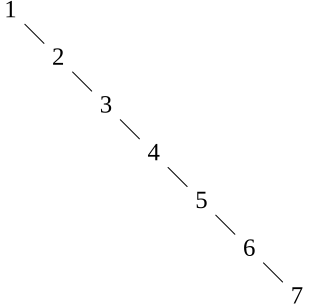
Figure 2.26
Unbalanced tree produced by adjoining 1 through 7 in sequence.
Each of the following two
functions
converts a
binary tree to a list.
function tree_to_list_1(tree) {
    return is_null(tree)
           ? null
           : append(tree_to_list_1(left_branch(tree)),
                    pair(entry(tree),
                         tree_to_list_1(right_branch(tree))));
}
function tree_to_list_2(tree) {
    function copy_to_list(tree, result_list) {
        return is_null(tree)
               ? result_list
               : copy_to_list(left_branch(tree),
                              pair(entry(tree),
                                   copy_to_list(right_branch(tree),
                                                result_list)));
    }
    return copy_to_list(tree, null);
}
-
Do the two functions have the same order of growth in the number of steps required to convert a balanced tree with $n$ elements to a list? If not, which one grows more slowly?
-
A balanced tree with $n$ elements has a height of $O(\log{n})$ and $O(n)$ nodes. To convert the tree into a list using function tree_to_list_1, we call tree_to_list_1 $O(n)$ times. We call append at each node of the tree, but at each level, we apply append with a combined $O(n)$ elements in the first arguments. Thus, the run time of tree_to_list_1 has an order of growth of $O(n\log{n})$. Instead of append, the function tree_to_list_2 gets away with calling pair at each node, and thus tree_to_list_2 has an order of growth of $O(n)$.
The following
function
list_to_tree
converts an ordered list to a balanced binary tree. The helper
function
partial_tree
takes as arguments an integer $n$ and list of
at least $n$ elements and constructs a balanced
tree containing the first $n$ elements of the
list. The result returned by
partial_tree
is a pair (formed with
pair)
whose
head
is the constructed tree and whose
tail
is the list of elements not included in the tree.
function list_to_tree(elements) {
    return head(partial_tree(elements, length(elements)));
}
function partial_tree(elts, n) {
    if (n === 0) {
        return pair(null, elts);
    } else {
        const left_size = math_floor((n - 1) / 2);
        const left_result = partial_tree(elts, left_size);
        const left_tree = head(left_result);
        const non_left_elts = tail(left_result);
        const right_size = n - (left_size + 1);
        const this_entry = head(non_left_elts);
        const right_result = partial_tree(tail(non_left_elts), right_size);
        const right_tree = head(right_result);
        const remaining_elts = tail(right_result);
        return pair(make_tree(this_entry, left_tree, right_tree),
                    remaining_elts);
    }
}
-
Write a short paragraph explaining as clearly as you can how partial_tree works. Draw the tree produced by list_to_tree for the list list(1, 3, 5, 7, 9, 11).
-
What is the order of growth in the number of steps required by list_to_tree to convert a list of $n$ elements?
-
The function partial_tree(elts, n) returns a pair whose head is a balanced tree for the first $\lfloor (n - 1) / 2 \rfloor$ elements of elts, and whose tail is the list containing the remaining elements of elts. It works by calling itself recursively, to construct the left subtree and right subtree, and then makes the tree, and the required return pair. Thus, the overall function list_to_tree just needs to call partial_tree with the given list and its length, and return the head of the result. The tree for list(1, 3, 5, 7, 9, 11) is the tree on the right in figure 2.25.
-
The order of growth for the run time of function list_to_tree is $O(n)$ because for every node of the result tree, only a constant amount of work is needed.
for sets implemented as (balanced) binary trees.
[5]
function union_set_as_tree(set1, set2) {
    const list1 = tree_to_list_2(set1);
    const list2 = tree_to_list_2(set2);
    return list_to_tree(union_set(list1, list2));
}
function intersection_set_as_tree(set1, set2) {
    const list1=tree_to_list_2(set1);
    const list2=tree_to_list_2(set2);
    return list_to_tree(intersection_set(list1, list2));
}
We have examined options for using lists to represent sets and have
seen how the choice of representation for a data object can have a
large impact on the performance of the programs that use the data.
Another reason for concentrating on sets is that the techniques
discussed here appear again and again in applications involving
information retrieval.
Consider a data base containing a large number of individual records,
such as the personnel files for a company or the transactions in an
accounting system. A typical data-management system spends a large
amount of time accessing or modifying the data in the records and
therefore requires an efficient method for accessing records. This is
done by identifying a part of each record to serve as an identifying
key. A key can be anything that uniquely identifies the
record. For a personnel file, it might be an employee's ID number.
For an accounting system, it might be a transaction number. Whatever
the key is, when we define the record as a data structure we should
include a
key selector
function
that retrieves the key associated with a given record.
Now we represent the data base as a set of records. To locate the record
with a given key we use a
function
lookup, which takes as arguments a key and a
data base and which returns the record that has that key, or false if there
is no such record.
The function lookup
is implemented in almost the same way as
is_element_of_set.
For example, if the set of records is implemented as an unordered list, we
could use
function lookup(given_key, set_of_records) {
    return is_null(set_of_records)
           ? false
           : equal(given_key, key(head(set_of_records)))
           ? head(set_of_records)
           : lookup(given_key, tail(set_of_records));
}
Of course, there are better ways to represent large sets than as unordered
lists. Information-retrieval systems in which records have to be
randomly accessedare typically implemented by a tree-based method, such as the binary-tree representation discussed previously. In designing such a system the methodology of data abstraction can be a great help. The designer can create an initial implementation using a simple, straightforward representation such as unordered lists. This will be unsuitable for the eventual system, but it can be useful in providing a
quick and dirtydata base with which to test the rest of the system. Later on, the data representation can be modified to be more sophisticated. If the data base is accessed in terms of abstract selectors and constructors, this change in representation will not require any changes to the rest of the system.
Implement the lookup
function
for the case where the set of records is structured as a binary tree,
ordered by the numerical values of the keys.
function lookup(given_key, tree_of_records) {
    if (is_null(tree_of_records)) {
        return null;
    } else {
        const this_entry = entry(tree_of_records);
        const this_key = key(this_entry);
        return given_key === this_key
               ? this_entry
               : given_key < this_key
               ? lookup(given_key,
                        left_branch(tree_of_records))
               : lookup(given_key,
                        right_branch(tree_of_records));
    }
}
[1]
If we want to be more formal, we can specify
consistent with the interpretations given aboveto mean that the operations satisfy a collection of rules such as these:
-
For any set S and any object
x,
is_element_of_set(x, adjoin_set(x, S))
is true (informally:
Adjoining an object to a set produces a set that contains the object
). -
For any sets S and
T and any object
x,
is_element_of_set(x, union_set(S, T))
is equal to
is_element_of_set(x, S) || is_element_of_set(x, T)
(informally:
The elements of union_set(S, T) are the elements that are in S or in T
). -
For any object x,
is_element_of_set(x, null)
is false (informally:
No object is an element of the empty set
).
[3]
We
are representing sets in terms of trees, and trees in terms of
lists—in effect, a data abstraction built upon a data abstraction.
We can regard the
functions
entry,
left_branch,
right_branch,
and
make_tree
as a way of isolating the abstraction of a
binary treefrom the particular way we might wish to represent such a tree in terms of list structure.
[4]
Examples of such structures include
B-trees and red-black trees. There is a large literature
on data structures devoted to this problem. See
Cormen, Leiserson, Rivest, and Stein 2022 .
2.3.3
Example: Representing Sets