Permalink copied!
In working with compound data, we've stressed how data abstraction
permits us to design programs without becoming enmeshed in the details
of data representations, and how abstraction preserves for us the
flexibility to experiment with alternative representations. In this
section, we introduce another powerful design principle for working
with data structures—the use of conventional interfaces.
In section 1.3 we saw how
program abstractions, implemented as higher-order
functions,
can capture common patterns in programs that deal with numerical data. Our
ability to formulate analogous operations for working with compound data
depends crucially on the style in which we manipulate our data structures.
Consider, for example, the following
function,
analogous to the
count_leaves
function
of section 2.2.2, which takes a tree as argument
and computes the sum of the squares of the leaves that are odd:
function sum_odd_squares(tree) {
    return is_null(tree)
           ? 0
           : ! is_pair(tree)
           ? is_odd(tree) ? square(tree) : 0
           : sum_odd_squares(head(tree)) +
             sum_odd_squares(tail(tree));
}
On the surface, this
function
is very different from the following one, which constructs a list of all
the even Fibonacci numbers
${\textrm{Fib}}(k)$, where
$k$ is less than or equal to a given integer
$n$:
function even_fibs(n) {
    function next(k) {
        if (k > n) {
            return null;
        } else {
            const f = fib(k);
            return is_even(f)
                   ? pair(f, next(k + 1))
                   : next(k + 1);
        }
    }
    return next(0);
}
Despite the fact that these two
functions
are structurally very different, a more abstract description of the two
computations reveals a great deal of similarity. The first program
- enumerates the leaves of a tree;
- filters them, selecting the odd ones;
- squares each of the selected ones; and
- accumulates the results using +, starting with 0.
- enumerates the integers from 0 to $n$;
- computes the Fibonacci number for each integer;
- filters them, selecting the even ones; and
- accumulates the results using pair, starting with the empty list.
A signal-processing engineer would find it natural to conceptualize these
processes in terms of
signals flowing through a cascade of stages, each of
which implements part of the program plan, as shown in
figure 2.14.
In
sum_odd_squares,
we begin with an
enumerator, which generates a
signalconsisting of the leaves of a given tree. This signal is passed through a filter, which eliminates all but the odd elements. The resulting signal is in turn passed through a map, which is a
transducerthat applies the square function to each element. The output of the map is then fed to an accumulator, which combines the elements using +, starting from an initial 0. The plan for even_fibs is analogous.
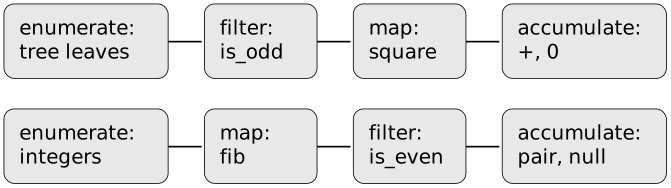
Figure 2.14
The signal-flow plans for the
functions
sum_odd_squares (top) and
even_fibs (bottom) reveal the
commonality between the two programs.
Unfortunately, the two
function declarations
above fail to exhibit this signal-flow structure. For instance, if we
examine the
sum_odd_squares
function,
we find that the enumeration is implemented partly by the
is_null
and
is_pair
tests and partly by the tree-recursive structure of the
function.
Similarly, the accumulation is found partly in the tests and partly in the
addition used in the recursion. In general, there are no distinct parts of
either
function
that correspond to the elements in the signal-flow description. Our two
functions
decompose the computations in a different way, spreading the enumeration
over the program and mingling it with the map, the filter, and the
accumulation. If we could organize our programs to make the signal-flow
structure manifest in the
functions
we write, this would increase the conceptual clarity of the resulting
program.
The key to organizing programs so as to more clearly reflect the
signal-flow structure is to concentrate on the
signalsthat flow from one stage in the process to the next. If we represent these signals as lists, then we can use list operations to implement the processing at each of the stages. For instance, we can implement the mapping stages of the signal-flow diagrams using the map function from section 2.2.1:
map(square, list(1, 2, 3, 4, 5));
list(1, 4, 9, 16, 25)
Filtering a sequence to select only those elements that satisfy a given
predicate is accomplished by
function filter(predicate, sequence) {
    return is_null(sequence)
           ? null
           : predicate(head(sequence))
           ? pair(head(sequence),
                  filter(predicate, tail(sequence)))
           : filter(predicate, tail(sequence));
}
For example,
filter(is_odd, list(1, 2, 3, 4, 5));
list(1, 3, 5)
Accumulations can be implemented by
function accumulate(op, initial, sequence) {
    return is_null(sequence)
           ? initial
           : op(head(sequence),
                accumulate(op, initial, tail(sequence)));
}
accumulate(plus, 0, list(1, 2, 3, 4, 5));
15
accumulate(times, 1, list(1, 2, 3, 4, 5));
120
accumulate(pair, null, list(1, 2, 3, 4, 5));
list(1, 2, 3, 4, 5)
All that remains to implement signal-flow diagrams is to enumerate the
sequence of elements to be processed. For
even_fibs,
we need to generate the sequence of integers in a given range, which we
can do as follows:
function enumerate_interval(low, high) {
    return low > high
           ? null
           : pair(low,
                  enumerate_interval(low + 1, high));
}
enumerate_interval(2, 7);
list(2, 3, 4, 5, 6, 7)
To enumerate the leaves of a tree, we can use
[1]
function enumerate_tree(tree) {
    return is_null(tree)
           ? null
           : ! is_pair(tree)
           ? list(tree)
           : append(enumerate_tree(head(tree)),
                    enumerate_tree(tail(tree)));
}
enumerate_tree(list(1, list(2, list(3, 4)), 5));
list(1, 2, 3, 4, 5)
Now we can reformulate
sum_odd_squares
and
even_fibs
as in the signal-flow diagrams. For
sum_odd_squares,
we enumerate the sequence of leaves of the tree, filter this to keep only
the odd numbers in the sequence, square each element, and sum the results:
function sum_odd_squares(tree) {
    return accumulate(plus,
                      0,
                      map(square,
                          filter(is_odd,
                                 enumerate_tree(tree))));
}
For
even_fibs,
we enumerate the integers from 0 to $n$, generate
the Fibonacci number for each of these integers, filter the resulting
sequence to keep only the even elements, and accumulate the results
into a list:
function even_fibs(n) {
    return accumulate(pair,
                      null,
                      filter(is_even,
                             map(fib,
                                 enumerate_interval(0, n))));
}
The value of expressing programs as sequence operations is that this
helps us make program designs that are modular, that is, designs that
are constructed by combining relatively independent pieces. We can
encourage modular design by providing a library of standard components
together with a conventional interface for connecting the components
in flexible ways.
Modular construction
is a powerful strategy for controlling complexity in
engineering design. In real signal-processing applications, for example,
designers regularly build systems by cascading elements selected from
standardized families of filters and transducers. Similarly, sequence
operations provide a library of standard program elements that we can mix
and match. For instance, we can reuse pieces from the
sum_odd_squares
and
even_fibs
functions
in a program that constructs a list of the squares of the first
$n+1$ Fibonacci numbers:
function list_fib_squares(n) {
    return accumulate(pair,
                      null,
                      map(square,
                          map(fib,
                              enumerate_interval(0, n))));
}
list_fib_squares(10);
list(0, 1, 1, 4, 9, 25, 64, 169, 441, 1156, 3025)
We can rearrange the pieces and use them in computing the product of the
squares of the odd integers in a sequence:
function product_of_squares_of_odd_elements(sequence) {
    return accumulate(times,
                      1,
                      map(square,
                          filter(is_odd, sequence)));
}
product_of_squares_of_odd_elements(list(1, 2, 3, 4, 5));
225
We can also formulate conventional data-processing applications in terms of
sequence operations. Suppose we have a sequence of personnel records and
we want to find the salary of the highest-paid programmer. Assume that we
have a selector salary that returns the salary
of a record, and a predicate
is_programmer
that tests if a record is for a programmer. Then we can write
function salary_of_highest_paid_programmer(records) {
    return accumulate(math_max,
                      0,
                      map(salary,
                          filter(is_programmer, records)));
}
These examples give just a hint of the vast range of operations that
can be expressed as sequence operations.
[2]
Sequences, implemented here as lists, serve as a conventional interface
that permits us to combine processing modules. Additionally, when we
uniformly represent structures as sequences, we have localized the
data-structure dependencies in our programs to a small number of sequence
operations. By changing these, we can experiment with alternative
representations of sequences, while leaving the overall design of our
programs intact. We will exploit this capability in
section 3.5, when we generalize the
sequence-processing paradigm to admit infinite sequences.
Fill in the missing expressions to complete the following definitions of
some basic list-manipulation operations as accumulations:
function map(f, sequence) {
return accumulate((x, y) => $\langle{}$??$\rangle$,
null, sequence);
}
function append(seq1, seq2) {
return accumulate(pair, $\langle{}$??$\rangle$, $\langle{}$??$\rangle$);
}
function length(sequence) {
return accumulate($\langle{}$??$\rangle$, 0, sequence);
}
function map(f, sequence) {
    return accumulate((x, y) => pair(f(x), y),
                      null,
                      sequence);
}
function append(seq1, seq2) {
    return accumulate(pair, seq2, seq1);
}
function length(sequence) {
    return accumulate((x, y) => y + 1,
                      0,
                      sequence);
}
Evaluating a
polynomial in $x$ at a given value
of $x$ can be formulated as an accumulation.
We evaluate the polynomial
\[ a_{n} x^n +a_{n-1}x^{n-1}+\cdots + a_{1} x+a_{0} \]
using a well-known algorithm called
Horner's rule, which structures the computation as
\[ \left(\cdots (a_{n} x+a_{n-1})x+\cdots +a_{1}\right) x+a_{0} \]
In other words, we start with $a_{n}$, multiply
by $x$, add $a_{n-1}$,
multiply by $x$, and so on, until we reach
$a_{0}$.
[3]
Fill in the following template to produce a
function
that evaluates a polynomial using Horner's rule. Assume that the
coefficients of the polynomial are arranged in a sequence, from
$a_{0}$ through
$a_{n}$.
function horner_eval(x, coefficient_sequence) {
return accumulate((this_coeff, higher_terms) => $\langle{}$??$\rangle$,
0,
coefficient_sequence);
}
For example, to compute $1+3x+5x^3+x^5$ at
$x=2$ you would evaluate
horner_eval(2, list(1, 3, 0, 5, 0, 1));
function horner_eval(x, coefficient_sequence) {
    return accumulate((this_coeff, higher_terms) =>
                      x * higher_terms + this_coeff,
                      0,
                      coefficient_sequence);
}
function count_leaves(t) {
    return accumulate((leaves, total) => leaves + total,
                      0,
		      map(sub_tree => is_pair(sub_tree)
		                      ? count_leaves(sub_tree)
                                      : 1,
			  t));
}
The
function
accumulate_n
is similar to
accumulate
except that it takes as its third argument a sequence of sequences, which
are all assumed to have the same number of elements. It applies the
designated accumulation
function
to combine all the first elements of the sequences, all the second elements
of the sequences, and so on, and returns a sequence of the results. For
instance, if s is a sequence containing four
sequences
list(list(1, 2, 3), list(4, 5, 6), list(7, 8, 9), list(10, 11, 12))
then the value of
accumulate_n(plus, 0, s)
should be the sequence
list(22, 26, 30).
Fill in the missing expressions in the following definition of
accumulate_n:
function accumulate_n(op, init, seqs) {
return is_null(head(seqs))
? null
: pair(accumulate(op, init, $\langle{}$??$\rangle$),
accumulate_n(op, init, $\langle{}$??$\rangle$));
}
function accumulate_n(op, init, seqs) {
    return is_null(head(seqs))
           ? null
           : pair(accumulate(op, init, map(x => head(x), seqs)),
                  accumulate_n(op, init, map(x => tail(x), seqs)));
}
Suppose we represent vectors $v=(v_{i})$ as
sequences of numbers, and matrices $m=(m_{ij})$
as sequences of vectors (the rows of the matrix). For example, the matrix
\[ \left[
\begin{array}{llll}
1 & 2 & 3 & 4\\
4 & 5 & 6 & 6\\
6 & 7 & 8 & 9\\
\end{array}
\right] \]
is represented as the following sequence:
list(list(1, 2, 3, 4),
     list(4, 5, 6, 6),
     list(6, 7, 8, 9))
With this representation, we can use sequence operations to concisely
express the basic matrix and vector operations. These operations
(which are described in any book on matrix algebra) are the following:
| dot_product($v$, $w$) |
returns the sum $\sum_{i}v_{i} w_{i}$;
|
| matrix_times_vector($m$, $v$) |
returns the vector $t$, where
$t_{i} =\sum_{j}m_{ij}v_{j}$;
|
| matrix_times_matrix($m$, $n$) |
returns the matrix $p$, where
$p_{ij}=\sum_{k} m_{ik}n_{kj}$;
|
| transpose($m$) |
returns the matrix $n$, where
$n_{ij}=m_{ji}$.
|
We can define the dot product as
[4]
function dot_product(v, w) {
    return accumulate(plus, 0, accumulate_n(times, 1, list(v, w)));
}
Fill in the missing expressions in the following
functions
for computing the other matrix operations. (The
function
accumulate_n
is declared in
exercise 2.36.)
function matrix_times_vector(m, v) {
return map($\langle{}$??$\rangle$, m);
}
function transpose(mat) {
return accumulate_n($\langle{}$??$\rangle$, $\langle{}$??$\rangle$, mat);
}
function matrix_times_matrix(m, n) {
const cols = transpose(n);
return map($\langle{}$??$\rangle$, m);
}
function matrix_times_vector(m, v) {
    return map(row => dot_product(row, v), m);
}
function transpose(mat) {
    return accumulate_n(pair, null, mat);
}
function matrix_times_matrix(n, m) {
    const cols = transpose(m);
    return map(x => map(y => dot_product(x, y), cols), n);
}
The
accumulate
function
is also known as
fold_right,
because it combines the first element of the sequence with the result
of combining all the elements to the right. There is also a
fold_left,
which is similar to
fold_right,
except that it combines elements working in the opposite direction:
function fold_left(op, initial, sequence) {
    function iter(result, rest) {
        return is_null(rest)
               ? result
               : iter(op(result, head(rest)),
                      tail(rest));
    }
    return iter(initial, sequence);
}
What are the values of
fold_right(divide, 1, list(1, 2, 3));
fold_left(divide, 1, list(1, 2, 3));
fold_right(list, null, list(1, 2, 3));
fold_left(list, null, list(1, 2, 3));
Give a property that
op
should satisfy to guarantee that
fold_right
and
fold_left
will produce the same values for any sequence.
-
1.5
-
0.16666666666666666
-
[1, [[2, [[3, [null, null]], null]], null]]
-
[[[null, [1, null]], [2, null]], [3, null]]
We can guarantee that fold_right
and fold_left produce
the same values for any sequence, if we require that
op is commutative and associative.
They also produce the same values, if
op is just associative and the
argument initial is a left and right
neutral element with respect to op.
fold_right(plus, 0, list(1, 2, 3));
fold_left(plus, 0, list(1, 2, 3));
Complete the following definitions of reverse
(exercise 2.18) in terms of
fold_right
and
fold_left
from exercise 2.38:
function reverse(sequence) {
return fold_right((x, y) => $\langle{}$??$\rangle$, null, sequence);
}
function reverse(sequence) {
return fold_left((x, y) => $\langle{}$??$\rangle$, null, sequence);
}
function reverse(sequence) {
    return fold_right((x, y) => append(y, list(x)),
                      null, sequence);
}
function reverse(sequence) {
    return fold_left((x, y) => pair(y, x), null, sequence);
}
We can extend the sequence paradigm to include many computations that are
commonly expressed using nested loops.
[5]
Consider this problem: Given a positive integer
$n$, find all ordered pairs of distinct positive
integers $i$ and $j$,
where $1\leq j < i\leq n$, such that
$i +j$ is prime. For example, if
$n$ is 6, then the pairs are the following:
\[
\begin{array}{c|ccccccc}
i & 2 & 3 & 4 & 4 & 5 & 6 & 6 \\
j & 1 & 2 & 1 & 3 & 2 & 1 & 5 \\
\hline
i+j & 3 & 5 & 5 & 7 & 7 & 7 & 11
\end{array}
\]
A natural way to organize this computation is to generate the sequence
of all ordered pairs of positive integers less than or equal to
$n$, filter to select those pairs whose sum is
prime, and then, for each pair $(i, j)$ that
passes through the filter, produce the triple
$(i, j, i+j)$.
Here is a way to generate the sequence of pairs: For each integer
$i\leq n$, enumerate the integers
$j < i$, and for each such
$i$ and $j$
generate the pair $(i, j)$. In terms of
sequence operations, we map along the sequence
enumerate_interval(1, n).
For each $i$ in this sequence, we map along the
sequence
enumerate_interval(1, i - 1).
For each $j$ in this latter sequence, we
generate the pair
list(i, j).
This gives us a sequence of pairs for each $i$.
Combining all the sequences for all the $i$ (by
accumulating with append) produces the
required sequence of pairs:
[6]
accumulate(append,
           null,
           map(i => map(j => list(i, j),
                        enumerate_interval(1, i - 1)),
               enumerate_interval(1, n)));
The combination of mapping and accumulating with
append is so common in this sort of program
that we will isolate it as a separate
function:
function flatmap(f, seq) {
    return accumulate(append, null, map(f, seq));
}
Now filter this sequence of pairs to find those whose sum is prime. The
filter predicate is called for each element of the sequence; its argument
is a pair and it must extract the integers from the pair. Thus, the
predicate to apply to each element in the sequence is
function is_prime_sum(pair) {
    return is_prime(head(pair) + head(tail(pair)));
}
Finally, generate the sequence of results by mapping over the filtered
pairs using the following
function,
which constructs a triple consisting of the two elements of the pair along
with their sum:
function make_pair_sum(pair) {
    return list(head(pair), head(tail(pair)),
                head(pair) + head(tail(pair)));
}
Combining all these steps yields the complete
function:
function prime_sum_pairs(n) {
    return map(make_pair_sum,
               filter(is_prime_sum,
                      flatmap(i => map(j => list(i, j),
                                       enumerate_interval(1, i - 1)),
                              enumerate_interval(1, n))));
}
Nested mappings are also useful for sequences other than those that
enumerate intervals. Suppose we wish to generate all the
permutations
of a set $S$; that is, all the ways of ordering
the items in the set. For instance, the permutations of
$\{1, 2, 3\}$ are
$\{1, 2, 3\}$,
$\{ 1, 3, 2\}$,
$\{2, 1, 3\}$,
$\{ 2, 3, 1\}$,
$\{ 3, 1, 2\}$, and
$\{ 3, 2, 1\}$. Here is a plan for generating
the permutations of $S$: For each item
$x$ in $S$,
recursively generate the sequence of permutations of
$S-x$,
[7]
and adjoin
$x$ to the front of each one. This yields, for
each $x$ in $S$, the
sequence of permutations of $S$ that begin
with $x$. Combining these sequences for
all $x$ gives all the permutations
of $S$:
[8]
function permutations(s) {
    return is_null(s)             // empty set?
           ? list(null)           // sequence containing empty set
           : flatmap(x => map(p => pair(x, p),
                              permutations(remove(x, s))),
                     s);
}
Notice how this strategy reduces the problem of generating permutations of
$S$ to the problem of generating the
permutations of sets with fewer elements than
$S$. In the terminal case, we work our way down
to the empty list, which represents a set of no elements. For this, we
generate
list(null),
which is a sequence with one item, namely the set with no elements. The
remove
function
used in permutations returns all the items in
a given sequence except for a given item. This can be expressed as a
simple filter:
function remove(item, sequence) {
    return filter(x => ! (x === item),
                  sequence);
}
Write a
function
unique_pairs
that, given an integer $n$, generates the
sequence of pairs $(i, j)$ with
$1\leq j < i\leq n$. Use
unique_pairs
to simplify the definition of
prime_sum_pairs
given above.
function unique_pairs(n) {
    return flatmap(i => map(j => list(i, j),
                            enumerate_interval(1, i - 1)),
                   enumerate_interval(1, n));
}
function prime_sum_pairs(n) {
    return map(make_pair_sum,
               filter(is_prime_sum,
                      unique_pairs(n)));
}
Write a
function
to find all ordered triples of distinct positive integers
$i$, $j$,
and $k$ less than or equal to a given
integer $n$ that sum to a given integer
$s$.
function unique_triples(n) {
    return flatmap(i => flatmap(j => map(k => list(i, j, k),
                                         enumerate_interval(1, j - 1)),
                                enumerate_interval(1, i - 1)),
                   enumerate_interval(1, n));
}
function plus(x, y) {
    return x + y;
}
function triples_that_sum_to(s, n) {
    return filter(items => accumulate(plus, 0, items) === s,
                  unique_triples(n));
}
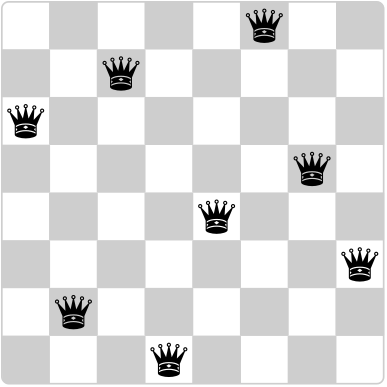
Figure 2.15
A solution to the eight-queens puzzle.
The
eight-queens puzzleasks how to place eight queens on a chessboard so that no queen is in check from any other (i.e., no two queens are in the same row, column, or diagonal). One possible solution is shown in figure 2.15. One way to solve the puzzle is to work across the board, placing a queen in each column. Once we have placed $k-1$ queens, we must place the $k$th queen in a position where it does not check any of the queens already on the board. We can formulate this approach recursively: Assume that we have already generated the sequence of all possible ways to place $k-1$ queens in the first $k-1$ columns of the board. For each of these ways, generate an extended set of positions by placing a queen in each row of the $k$th column. Now filter these, keeping only the positions for which the queen in the $k$th column is safe with respect to the other queens. This produces the sequence of all ways to place $k$ queens in the first $k$ columns. By continuing this process, we will produce not only one solution, but all solutions to the puzzle.
We implement this solution as a
function
queens,
which returns a sequence of all solutions to the problem of placing
$n$ queens on an
$n\times n$ chessboard.
The function queens
has an internal
function
queens_cols
that returns the sequence of all ways to place queens in the first
$k$ columns of the board.
function queens(board_size) {
    function queen_cols(k) {
        return k === 0
               ? list(empty_board)
               : filter(positions => is_safe(k, positions),
                        flatmap(rest_of_queens =>
                                  map(new_row =>
                                        adjoin_position(new_row, k,
                                                        rest_of_queens),
                                      enumerate_interval(1, board_size)),
                                queen_cols(k - 1)));
    }
    return queen_cols(board_size);
}
In this
function
rest_of_queens
is a way to place $k-1$ queens in the first
$k-1$ columns, and
new_row
is a proposed row in which to place the queen for the
$k$th column. Complete the program by
implementing the representation for sets of board positions, including the
function
adjoin_position,
which adjoins a new row-column position to a set of positions, and
empty_board,
which represents an empty set of positions. You must also write the
function
is_safe,
which determines for a set of positions whether the queen in the
$k$th column is safe with respect to the others.
(Note that we need only check whether the new queen is safe—the
other queens are already guaranteed safe with respect to each other.)
function adjoin_position(row, col, rest) {
    return pair(pair(row, col), rest);
}
const empty_board = null;
function is_safe(k, positions) {
    const first_row = head(head(positions));
    const first_col = tail(head(positions));
    return accumulate((pos, so_far) => {
                         const row = head(pos);
                         const col = tail(pos);
                         return so_far &&
                                first_row - first_col !==
                                row - col &&
                                first_row + first_col !==
                                row + col &&
                                first_row !== row;
                      },
                      true,
                      tail(positions));
}
Putting it all together:
// click here to see all solutions
Louis Reasoner is having a terrible time doing
exercise 2.42. His
queens
function
seems to work, but it runs extremely slowly. (Louis never does manage to
wait long enough for it to solve even the
$6\times 6$ case.) When Louis asks Eva Lu Ator
for help, she points out that he has interchanged the order of the nested
mappings in the
flatmap,
writing it as
flatmap(new_row =>
          map(rest_of_queens =>
                adjoin_position(new_row, k, rest_of_queens),
              queen_cols(k - 1)),
        enumerate_interval(1, board_size));
[2]
Richard Waters (1979) developed a program that automatically analyzes
traditional
Fortran programs, viewing them in terms of maps, filters, and accumulations.
He found that fully 90 percent of the code in the Fortran Scientific
Subroutine Package fits neatly into this paradigm. One of the reasons
for the success of Lisp as a programming language is that lists provide a
standard medium for expressing ordered collections so that they can be
manipulated using higher-order operations. Many modern languages, such as
Python, have learned this lesson.
[3]
According to
Knuth (1997b), this rule was formulated by
W. G. Horner early in the nineteenth century, but the method was actually
used by Newton over a hundred years earlier. Horner's rule evaluates
the polynomial using fewer additions and multiplications than does the
straightforward method of first computing
$a_{n} x^n$, then adding
$a_{n-1}x^{n-1}$, and so on. In fact, it is
possible to prove that any algorithm for evaluating arbitrary polynomials
must use at least as many additions and multiplications as does
Horner's rule, and thus Horner's rule is an
optimal algorithm for polynomial evaluation. This was proved (for the
number of additions) by
A. M. Ostrowski in a 1954 paper that essentially founded the modern study
of optimal algorithms. The analogous statement for multiplications was
proved by
V. Y. Pan in 1966. The book by
Borodin and Munro (1975)
provides an overview of these and other results about optimal
algorithms.
[5]
This approach to nested
mappings was shown to us by
David Turner, whose languages
KRC and
Miranda provide elegant formalisms for dealing with these constructs. The
examples in this section (see also
exercise 2.42) are adapted from Turner 1981.
In section 3.5.3, we'll see
how this approach generalizes to infinite sequences.
[6]
We're representing a pair here
as a list of two elements rather than as
an ordinary pair.
Thus, the
pair$(i, j)$ is represented as list(i, j), not pair(i, j).
[7]
The set
$S-x$ is the set of all elements of
$S$, excluding
$x$.
[8]
The character sequence //
in JavaScript programs is
used to introduce comments. Everything from
//
to the end of the line is ignored by the interpreter. In this book we
don't use many comments; we try to make our programs self-documenting
by using descriptive names.
2.2.3
Sequences as Conventional Interfaces