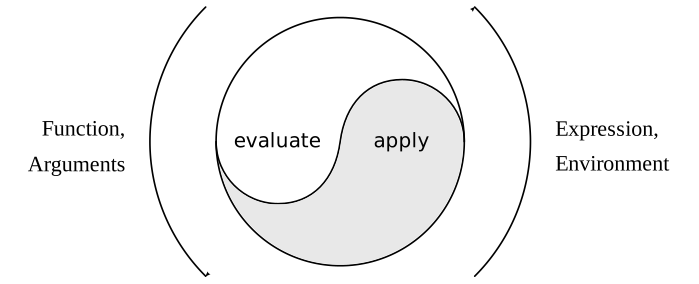
The function evaluate takes as arguments a program component—a statement or expression[1]—and an environment. It classifies the component and directs its evaluation. The function evaluate is structured as a case analysis of the syntactic type of the component to be evaluated. In order to keep the function general, we express the determination of the type of a component abstractly, making no commitment to any particular representation for the various types of components. Each type of component has a syntax predicate that tests for it and an abstract means for selecting its parts. This abstract syntax makes it easy to see how we can change the syntax of the language by using the same evaluator, but with a different collection of syntax functions.
- For literal expressions, such as numbers, evaluate returns their value.
- The function evaluate must look up names in the environment to find their values.
- For a function application, evaluate must recursively evaluate the function expression and the argument expressions of the application. The resulting function and arguments are passed to apply, which handles the actual function application.
- An operator combination is transformed into a function application and then evaluated.
- A conditional expression or statement requires special processing of its parts, so as to evaluate the consequent if the predicate is true, and otherwise to evaluate the alternative.
- A lambda expression must be transformed into an applicable function by packaging together the parameters and body specified by the lambda expression with the environment of the evaluation.
- A sequence of statements requires evaluating its components in the order in which they appear.
- A block requires evaluating its body in a new environment that reflects all names declared within the block.
- A return statement must produce a value that becomes the result of the function call that gave rise to the evaluation of the return statement.
- A function declaration is transformed into a constant declaration and then evaluated.
- A constant or variable declaration or an assignment must call evaluate recursively to compute the new value to be associated with the name being declared or assigned. The environment must be modified to reflect the new value of the name.
function evaluate(component, env) {
    return is_literal(component)
           ? literal_value(component)
           : is_name(component)
           ? lookup_symbol_value(symbol_of_name(component), env)
           : is_application(component)
           ? apply(evaluate(function_expression(component), env),
                   list_of_values(arg_expressions(component), env))
           : is_operator_combination(component)
           ? evaluate(operator_combination_to_application(component),
                      env)
           : is_conditional(component)
           ? eval_conditional(component, env)
           : is_lambda_expression(component)
           ? make_function(lambda_parameter_symbols(component),
                           lambda_body(component), env)
           : is_sequence(component)
           ? eval_sequence(sequence_statements(component), env)
           : is_block(component)
           ? eval_block(component, env)
           : is_return_statement(component)
           ? eval_return_statement(component, env)
           : is_function_declaration(component)
           ? evaluate(function_decl_to_constant_decl(component), env)
           : is_declaration(component)
           ? eval_declaration(component, env)
           : is_assignment(component)
           ? eval_assignment(component, env)
           : error(component, "unknown syntax -- evaluate");
}
For clarity, evaluate has been implemented as a case analysis using conditional expressions. The disadvantage of this is that our function handles only a few distinguishable types of statements and expressions, and no new ones can be defined without editing the declaration of evaluate. In most interpreter implementations, dispatching on the type of a component is done in a data-directed style. This allows a user to add new types of components that evaluate can distinguish, without modifying the declaration of evaluate itself. (See exercise 4.3.)
The representation of names is handled by the syntax abstractions. Internally, the evaluator uses strings to represent names, and we refer to such strings as symbols. The function symbol_of_name used in evaluate extracts from a name the symbol by which it is represented.
The function apply takes two arguments, a function and a list of arguments to which the function should be applied. The function apply classifies functions into two kinds: It calls apply_primitive_function to apply primitives; it applies compound functions by evaluating the block that makes up the body of the function. The environment for the evaluation of the body of a compound function is constructed by extending the base environment carried by the function to include a frame that binds the parameters of the function to the arguments to which the function is to be applied. Here is the declaration of apply:
function apply(fun, args) {
    if (is_primitive_function(fun)) {
        return apply_primitive_function(fun, args);
    } else if (is_compound_function(fun)) {
        const result = evaluate(function_body(fun),
                                extend_environment(
                                    function_parameters(fun),
                                    args,
                                    function_environment(fun)));
        return is_return_value(result)
               ? return_value_content(result)
               : undefined;
    } else {
        error(fun, "unknown function type -- apply");
    }
}
When evaluate processes a function application, it uses list_of_values to produce the list of arguments to which the function is to be applied. The function list_of_values takes as an argument the argument expressions of the application. It evaluates each argument expression and returns a list of the corresponding values:[3]
function list_of_values(exps, env) {
    return map(arg => evaluate(arg, env), exps);
}
The function eval_conditional evaluates the predicate part of a conditional component in the given environment. If the result is true, the consequent is evaluated, otherwise the alternative is evaluated:
function eval_conditional(component, env) {
    return is_truthy(evaluate(conditional_predicate(component), env))
           ? evaluate(conditional_consequent(component), env)
           : evaluate(conditional_alternative(component), env);
}
The use of is_truthy in eval_conditional highlights the issue of the connection between an implemented language and an implementation language. The conditional_predicate is evaluated in the language being implemented and thus yields a value in that language. The interpreter predicate is_truthy translates that value into a value that can be tested by the conditional expression in the implementation language: The metacircular representation of truth might not be the same as that of the underlying JavaScript.[4]
The function eval_sequence is used by evaluate to evaluate a sequence of statements at the top level or in a block. It takes as arguments a sequence of statements and an environment, and evaluates the statements in the order in which they occur. The value returned is the value of the final statement, except that if the evaluation of any statement in the sequence yields a return value, that value is returned and the subsequent statements are ignored.[5]
function eval_sequence(stmts, env) {
    if (is_empty_sequence(stmts)) {
        return undefined;
    } else if (is_last_statement(stmts)) {
        return evaluate(first_statement(stmts), env);
    } else {
        const first_stmt_value =
            evaluate(first_statement(stmts), env);
        if (is_return_value(first_stmt_value)) {
            return first_stmt_value;
        } else {
            return eval_sequence(rest_statements(stmts), env);
        }
    }
}
The function eval_block handles
blocks. The variables and constants (including functions)
declared in the block have the whole block as their scope and thus
are scanned out
before the body of the block is
evaluated.
The body of the block is evaluated with respect to an environment
that extends the current
environment by a frame that binds each local name
to a special value,
"*unassigned*".
This string serves as a placeholder, before
the evaluation of the declaration assigns the name
its proper value. An attempt to access the value of the name before its
declaration is evaluated leads to an error at run time (see
exercise 4.12), as stated in
footnote undefined in chapter 1.
function eval_block(component, env) {
    const body = block_body(component);
    const locals = scan_out_declarations(body);
    const unassigneds = list_of_unassigned(locals);
    return evaluate(body, extend_environment(locals,
                                             unassigneds,
                                             env));
}
function list_of_unassigned(symbols) {
    return map(symbol => "*unassigned*", symbols);
}
function scan_out_declarations(component) {
    return is_sequence(component)
           ? accumulate(append,
                        null,
                        map(scan_out_declarations,
                            sequence_statements(component)))
           : is_declaration(component)
           ? list(declaration_symbol(component))
           : null;
}
The function eval_return_statement is used to evaluate return statements. As seen in apply and the evaluation of sequences, the result of evaluation of a return statement needs to be identifiable so that the evaluation of a function body can return immediately, even if there are statements after the return statement. For this purpose, the evaluation of a return statement wraps the result of evaluating the return expression in a return value object.[6]
function eval_return_statement(component, env) {
    return make_return_value(evaluate(return_expression(component),
                                      env));
}
The function eval_assignment handles assignments to names. (To simplify the presentation of our evaluator, we are allowing assignment not just to variables but also—erroneously—to constants. Exercise 4.11 explains how we could distinguish constants from variables and prevent assignment to constants.) The function eval_assignment calls evaluate on the value expression to find the value to be assigned and calls assignment_symbol to retrieve the symbol that represents the name from the assignment. The function eval_assignment transmits the symbol and the value to assign_symbol_value to be installed in the designated environment. The evaluation of an assignment returns the value that was assigned.
function eval_assignment(component, env) {
    const value = evaluate(assignment_value_expression(component),
                           env);
    assign_symbol_value(assignment_symbol(component), value, env);
    return value;
}
Constant and variable declarations are both recognized by the is_declaration syntax predicate. They are treated in a manner similar to assignments, because eval_block has already bound their symbols to "*unassigned*" in the current environment. Their evaluation replaces "*unassigned*" with the result of evaluating the value expression.
function eval_declaration(component, env) {
    assign_symbol_value(
        declaration_symbol(component),
        evaluate(declaration_value_expression(component), env),
        env);
    return undefined;
}
function list_of_values(exps, env) {
    return is_null(exps)
           ? null
           : pair(evaluate(head(exps), env),
                  list_of_values(tail(exps), env));
}