Permalink copied!
The basic operations on
pairs—pair,
head,
and
tail—can
be used to construct list structure and to select parts
from list structure, but they are incapable of modifying list
structure. The same is true of the list operations we have used so
far, such as append and
list, since these can be defined in terms of
pair,
head,
and
tail.
To modify list structures we need new operations.
The primitive mutators for pairs are
set_head
and
set_tail.
The function set_head
takes two arguments, the first of which must be a pair. It modifies this
pair, replacing the
head
pointer by a pointer to the second argument of
set_head.
[1]
As an example, suppose that x is bound to
list(list("a", "b"), "c", "d")
and y to
list("e", "f")
as illustrated in
figure 3.24.
Evaluating the expression
set_head(x, y)
modifies the pair to which x is bound,
replacing its
head
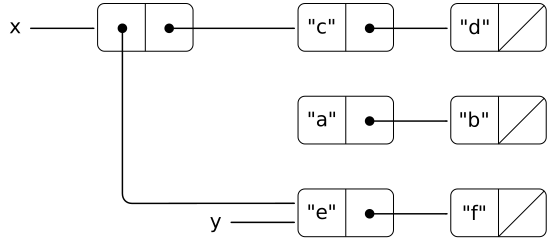
by the value of y. The result of the operation
is shown in
figure 3.26.
The structure x has been modified and
is now equivalent to
list(list("e", "f"), "c", "d").
The pairs representing the list
list("a", "b"),
identified by the pointer that was replaced, are now detached from the
original structure.
[2]
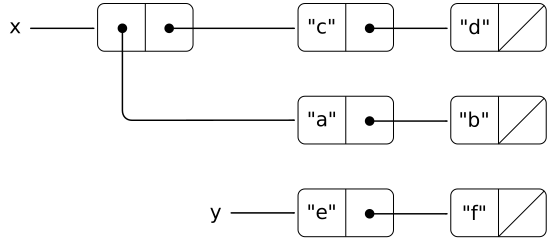
Figure 3.24
Lists x:
list(list("a", "b"), "c", "d")
and y:
list("e", "f").
The
set_tail
operation is similar to
set_head.
The only difference is that the
tail
pointer of the pair, rather than the
head
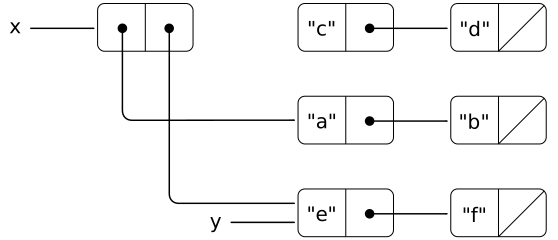
pointer, is replaced. The effect of executing
set_tail(x, y)
on the lists of
figure 3.24
is shown in
figure 3.30.
Here the
tail
pointer of
x has been replaced by the pointer to
list("e", "f").
Also, the list
list("c", "d"),
which used to be the
tail
of x, is now detached from the structure.
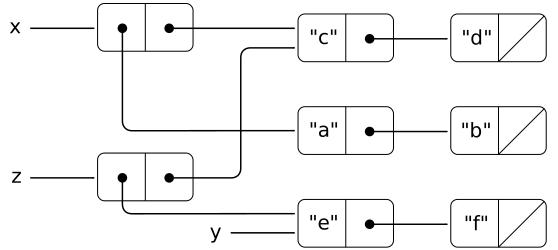
The function pair
builds new list structure by creating new pairs,
whereas set_head
and
set_tail
modify existing pairs.
Indeed, we could
implement
pair
in terms of the two mutators, together with a
function
get_new_pair,
which returns a new pair that is not part of any existing list structure.
We obtain the new pair, set its
head
and
tail
pointers to the designated objects, and return the new pair as the result of
the
pair.
[3]
function pair(x, y) {
    const fresh = get_new_pair();
    set_head(fresh, x);
    set_tail(fresh, y);
    return fresh;
}
function append(x, y) {
    return is_null(x)
           ? y
           : pair(head(x), append(tail(x), y));
}
The function append
forms a new list by successively
adjoining the elements of x
to the front of
y.
The
function
append_mutator
is similar to append, but it is a mutator
rather than a constructor. It appends the lists by splicing them together,
modifying the final pair of x so that its
tail
is now y. (It is an error to call
append_mutator
with an empty x.)
function append_mutator(x, y) {
    set_tail(last_pair(x), y);
    return x;
}
Here
last_pair
is a
function
that returns the last pair in its argument:
function last_pair(x) {
    return is_null(tail(x))
           ? x
           : last_pair(tail(x));
}
Consider the interaction
const x = list("a", "b");
const y = list("c", "d");
const z = append(x, y);
z;
["a", ["b", ["c", ["d, null]]]]
tail(x);
const w = append_mutator(x, y);
w;
["a", ["b", ["c", ["d", null]]]]
tail(x);
What are the missing $response$s?
Draw box-and-pointer diagrams to explain your answer.
There is currently no solution available for this exercise. This textbook adaptation is a community effort. Do consider contributing by providing a solution for this exercise, using a Pull Request in Github.
Consider the following
make_cycle
function,
which uses the
last_pair
function
defined in exercise 3.12:
function make_cycle(x) {
    set_tail(last_pair(x), x);
    return x;
}
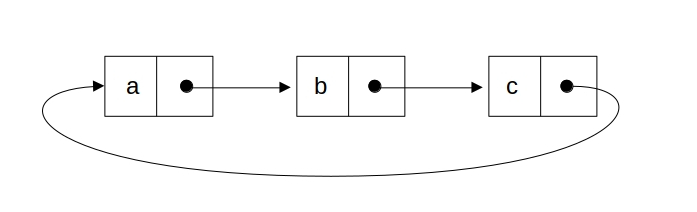
Draw a box-and-pointer diagram that shows the structure
z created by
const z = make_cycle(list("a", "b", "c"));
What happens if we try to compute
last_pair(z)?
(provided by GitHub user jonathantorres)
If we try to compute last_pair(z), the
program will enter in a infinite loop, since the end of the list points back
to the beginning.
The following
function
is quite useful, although obscure:
function mystery(x) {
    function loop(x, y) {
        if (is_null(x)) {
            return y;
        } else {
            const temp = tail(x);
            set_tail(x, y);
            return loop(temp, x);
        }
    }
    return loop(x, null);
}
The function loop
uses the
temporaryname temp to hold the old value of the tail of x, since the set_tail on the next line destroys the tail. Explain what mystery does in general. Suppose v is defined by
const v = list("a", "b", "c", "d");
Draw the box-and-pointer diagram that represents the list to which
v is bound. Suppose that we now evaluate
const w = mystery(v);
Draw box-and-pointer diagrams that show the structures
v and w after
evaluating this
program.
What would be printed as the values of v
and w?
(provided by GitHub user jonathantorres)
The application mystery(x) will
reverse the list x in-place.
Initially
v looks like this:
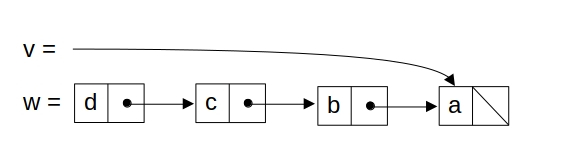
After evaluating
const w = mystery(v);
the values of
v and
w become:
The function display
prints ["a", null] for
v and
["d", ["c", ["b", ["a", null]]]] for
w.
We mentioned in section 3.1.3 the
theoretical issues of
samenessand
changeraised by the introduction of assignment. These issues arise in practice when individual pairs are shared among different data objects. For example, consider the structure formed by
const x = list("a", "b");
const z1 = pair(x, x);
As shown in
figure 3.32,
z1 is a pair whose
head
and
tail
both point to the same pair x. This sharing
of x by the
head
and
tail
of z1 is a consequence of the straightforward
way in which
pair
is implemented. In general, using
pair
to construct lists will result in an interlinked structure of pairs in
which many individual pairs are shared by many different structures.
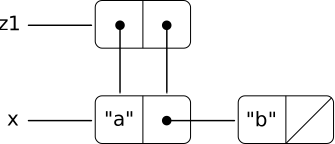
Figure 3.32
The list z1 formed by
pair(x, x).
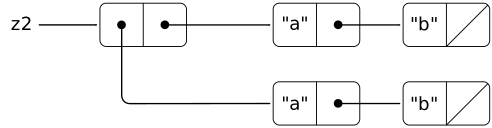
Figure 3.34
The list z2 formed by
pair(list("a", "b"), list("a", "b")).
const z2 = pair(list("a", "b"), list("a", "b"));
In this structure, the pairs in the two
list("a", "b")
lists are distinct, although
they contain the same strings.
[4]
When thought of as a list, z1 and
z2 both represent
the samelist:
list(list("a", "b"), "a", "b")
In general, sharing is completely undetectable if we operate on lists using
only
pair,
head,
and
tail.
However, if we allow mutators on list structure, sharing becomes
significant. As an example of the difference that sharing can make,
consider the following
function,
which modifies the
head
of the structure to which it is applied:
function set_to_wow(x) {
    set_head(head(x), "wow");
    return x;
}
Even though z1 and
z2 are
the samestructure, applying set_to_wow to them yields different results. With z1, altering the head also changes the tail, because in z1 the head and the tail are the same pair. With z2, the head and tail are distinct, so set_to_wow modifies only the head:
z1;
[["a", ["b", null]], ["a", ["b", null]]]
set_to_wow(z1);
[["wow", ["b", null]], ["wow", ["b", null]]]
z2;
>
[["a", ["b", null]], ["a", ["b", null]]]
set_to_wow(z2);
[["wow", ["b", null]], ["a", ["b", null]]]
One way to detect sharing in list structures is to use the
primitive predicate ===,
which we introduced in
section 1.1.6 to test whether two numbers
are equal
and extended in section 2.3.1 to test whether
two strings are equal. When applied to two nonprimitive values,
x === y
tests whether x and
y are the same object (that is, whether
x and y
are equal as pointers).
As will be seen in the following sections, we can exploit sharing to
greatly extend the repertoire of data structures that can be
represented by pairs. On the other hand, sharing can also be
dangerous, since modifications made to structures will also affect
other structures that happen to share the modified parts. The mutation
operations
set_head
and
set_tail
should be used with care; unless we have a good understanding of how our
data objects are shared, mutation can have unanticipated
results.
[5]
Draw box-and-pointer diagrams to explain the effect of
set_to_wow
on the structures z1 and
z2 above.
There is currently no solution available for this exercise. This textbook adaptation is a community effort. Do consider contributing by providing a solution for this exercise, using a Pull Request in Github.
Ben Bitdiddle decides to write a
function
to count the number of pairs in any list structure.
It's easy,he reasons.
The number of pairs in any structure is the number in the head plus the number in the tail plus one more to count the current pair.So Ben writes the following function
function count_pairs(x) {
    return ! is_pair(x)
           ? 0
           : count_pairs(head(x)) +
             count_pairs(tail(x)) +
             1;
}
Show that this
function
is not correct. In particular, draw box-and-pointer diagrams representing
list structures made up of exactly three pairs for which Ben's
function
would return 3; return 4; return 7; never return at all.
const three_list = list("a", "b", "c");
const one = pair("d", "e");
const two = pair(one, one);
const four_list = pair(two, "f");
const seven_list = pair(two, two);
const cycle = list("g", "h", "i");
set_tail(tail(tail(cycle)), cycle);
Devise a correct version of the
count_pairs
function
of exercise 3.16 that returns the number of
distinct pairs in any structure. (Hint: Traverse the structure, maintaining
an auxiliary data structure that is used to keep track of which pairs have
already been counted.)
// solution provided by GitHub user clean99

function count_pairs(x) {
    let counted_pairs = null;
    function is_counted_pair(current_counted_pairs, x) {
        return is_null(current_counted_pairs)
               ? false
               : head(current_counted_pairs) === x
               ? true
               : is_counted_pair(tail(current_counted_pairs), x);
    }
    function count(x) {
        if(! is_pair(x) || is_counted_pair(counted_pairs, x)) {
            return 0;
        } else {
            counted_pairs = pair(x, counted_pairs);
            return count(head(x)) +
                   count(tail(x)) +
                   1;
        }
    }
    return count(x);
}
Write a
function
that examines a list and
determines whether it contains a cycle, that is,
whether a program that tried to find the end of the list by taking
successive
tails
would go into an infinite loop. Exercise 3.13
constructed such lists.
// solution provided by GitHub user clean99

function contains_cycle(x) {
    let counted_pairs = null;
    function is_counted_pair(counted_pairs, x) {
        return is_null(counted_pairs)
               ? false
               : head(counted_pairs) === x
               ? true
               : is_counted_pair(tail(counted_pairs), x);
    }
    function detect_cycle(x) {
        if (is_null(x)) {
            return false;
        } else if (is_counted_pair(counted_pairs, x)) {
            return true;
        } else {
            counted_pairs = pair(x, counted_pairs);
            return detect_cycle(tail(x));
        }
    }
    return detect_cycle(x);
}
Redo exercise 3.18 using an algorithm that
takes only a constant amount of space. (This requires a very clever idea.)
Define a fast pointer and a slow pointer. The fast pointer goes forward
2 steps every time, while the slow pointer goes forward 1 step every time.
If there is a cycle in the list, the fast pointer will eventually catch
up with the slow pointer.
function contains_cycle(x) {
    function detect_cycle(fast, slow) {
        return is_null(fast) || is_null(tail(fast))
               ? false
               : fast === slow
               ? true
               : detect_cycle(tail(tail(fast)), tail(slow));
    }
    return detect_cycle(tail(x), x);
}
When we introduced compound data, we observed in
section 2.1.3 that pairs can be represented purely
in terms of
functions:
function pair(x, y) {
    function dispatch(m) {
        return m === "head"
               ? x
               : m === "tail"
               ? y
               : error(m, "undefined operation -- pair");
    }
    return dispatch;
}

function head(z) { return z("head"); }

function tail(z) { return z("tail"); }
The same observation is true for mutable data. We can implement
mutable data objects as
functions
using assignment and local state. For instance, we can extend the above
pair implementation to handle
set_head
and
set_tail
in a manner analogous to the way we implemented bank accounts using
make_account
in section 3.1.1:
function pair(x, y) {
    function set_x(v) { x = v; }
    function set_y(v) { y = v; }
    return m => m === "head"
                ? x
                : m === "tail"
                ? y
                : m === "set_head"
                ? set_x
                : m === "set_tail"
                ? set_y
                : error(m, "undefined operation -- pair");
}

function head(z) { return z("head"); }

function tail(z) { return z("tail"); }

function set_head(z, new_value) {
    z("set_head")(new_value);
    return z;
}
function set_tail(z, new_value) {
    z("set_tail")(new_value);
    return z;
}
Assignment is all that is needed, theoretically, to account for the
behavior of mutable data. As soon as we admit
assignment
to our language, we raise all the issues, not only of assignment, but of
mutable data in general.
[6]
Draw environment diagrams to illustrate the evaluation of the sequence
of
statements
const x = pair(1, 2);
const z = pair(x, x);
set_head(tail(z), 17);
head(x);
17
There is currently no solution available for this exercise. This textbook adaptation is a community effort. Do consider contributing by providing a solution for this exercise, using a Pull Request in Github.
[1]
The functions set_head and
set_tail return the value
undefined.
They should be used only for their effect.
[4]
The two pairs are distinct
because each call to pair
returns a new pair. The strings are
the samein the sense that they are primitive data (just like numbers) that are composed of the same characters in the same order. Since JavaScript provides no way to mutate a string, any sharing that the designers of a JavaScript interpreter might decide to implement for strings is undetectable. We consider primitive data such as numbers, booleans, and strings to be identical if and only if they are indistinguishable.
[5]
The subtleties of dealing with sharing of mutable data
objects reflect the underlying issues of
samenessand
changethat were raised in section 3.1.3. We mentioned there that admitting change to our language requires that a compound object must have an
identitythat is something different from the pieces from which it is composed. In JavaScript, we consider this
identityto be the quality that is tested by ===, i.e., by equality of pointers. Since in most JavaScript implementations a pointer is essentially a memory address, we are
solving the problemof defining the identity of objects by stipulating that a data object
itselfis the information stored in some particular set of memory locations in the computer. This suffices for simple JavaScript programs, but is hardly a general way to resolve the issue of
samenessin computational models.
[6]
On the other hand, from the viewpoint of
implementation, assignment requires us to modify the environment, which is
itself a mutable data structure. Thus, assignment and mutation are
equipotent: Each can be implemented in terms of the other.
3.3.1
Mutable List Structure