Permalink copied!
In the previous section, we saw how to design systems in which data
objects can be represented in more than one way. The key idea is to
link the code that specifies the data operations to the several
representations by means of generic interface
functions.
Now we will see how to use this same idea not only to define operations
that are generic over different representations but also to define
operations that are
generic over different kinds of arguments. We have
already seen several different packages of arithmetic operations: the
primitive arithmetic (+,
-, *,
/) built into our language, the
rational-number arithmetic
(add_rat,
sub_rat,
mul_rat,
div_rat)
of section 2.1.1, and the complex-number
arithmetic that we implemented in
section 2.4.3. We will now use
data-directed techniques to construct a package of arithmetic operations
that incorporates all the arithmetic packages we have already constructed.
前の節では、データオブジェクトを複数の方法で表現できるシステムの設計方法を見ました。鍵となるアイデアは、データ操作を指定するコードを、ジェネリックインターフェース
関数を通じて複数の表現にリンクすることでした。
ここでは、この同じアイデアを使って、異なる表現に対してジェネリックな演算を定義するだけでなく、異なる種類の引数に対しても
ジェネリックな演算を定義する方法を見ていきます。これまでに、いくつかの異なる算術演算パッケージを見てきました。言語に組み込まれたプリミティブな算術(+、
-、*、
/)、
節 2.1.1の有理数算術(
add_rat、
sub_rat、
mul_rat、
div_rat)、
そして節 2.4.3で実装した複素数算術です。ここでは、データ指向の手法を使って、これまでに構築したすべての算術パッケージを統合する算術演算パッケージを構築します。
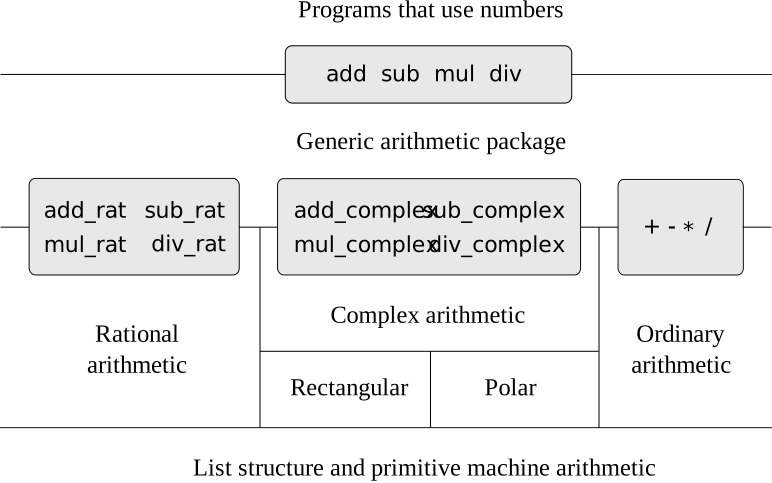
Figure 2.36
shows the structure of the system we
shall build. Notice the
abstraction barriers. From the perspective
of someone using
numbers,there is a single function add that operates on whatever numbers are supplied. The function add is part of a generic interface that allows the separate ordinary-arithmetic, rational-arithmetic, and complex-arithmetic packages to be accessed uniformly by programs that use numbers. Any individual arithmetic package (such as the complex package) may itself be accessed through generic functions (such as add_complex) that combine packages designed for different representations (such as rectangular and polar). Moreover, the structure of the system is additive, so that one can design the individual arithmetic packages separately and combine them to produce a generic arithmetic system.
図 2.36
は、これから構築するシステムの構造を示しています。
抽象バリアに注目してください。
数を使う人の視点からは、与えられた数が何であれそれに対して動作する単一の 関数 add があるだけです。 関数 add は、通常の算術、有理数算術、複素数算術の各パッケージを、数を使うプログラムから統一的にアクセスできるようにするジェネリックインターフェースの一部です。個々の算術パッケージ(例えば複素数パッケージ)は、それ自体がジェネリック 関数 (例えば add_complex) を通じてアクセスでき、異なる表現(直交形式や極形式など)のために設計されたパッケージを組み合わせます。さらに、このシステムの構造は加法的であり、個々の算術パッケージを別々に設計してから組み合わせて、ジェネリック算術システムを作ることができます。
2.5
Systems with Generic Operations
ジェネリック演算を持つシステム